Quick Answer
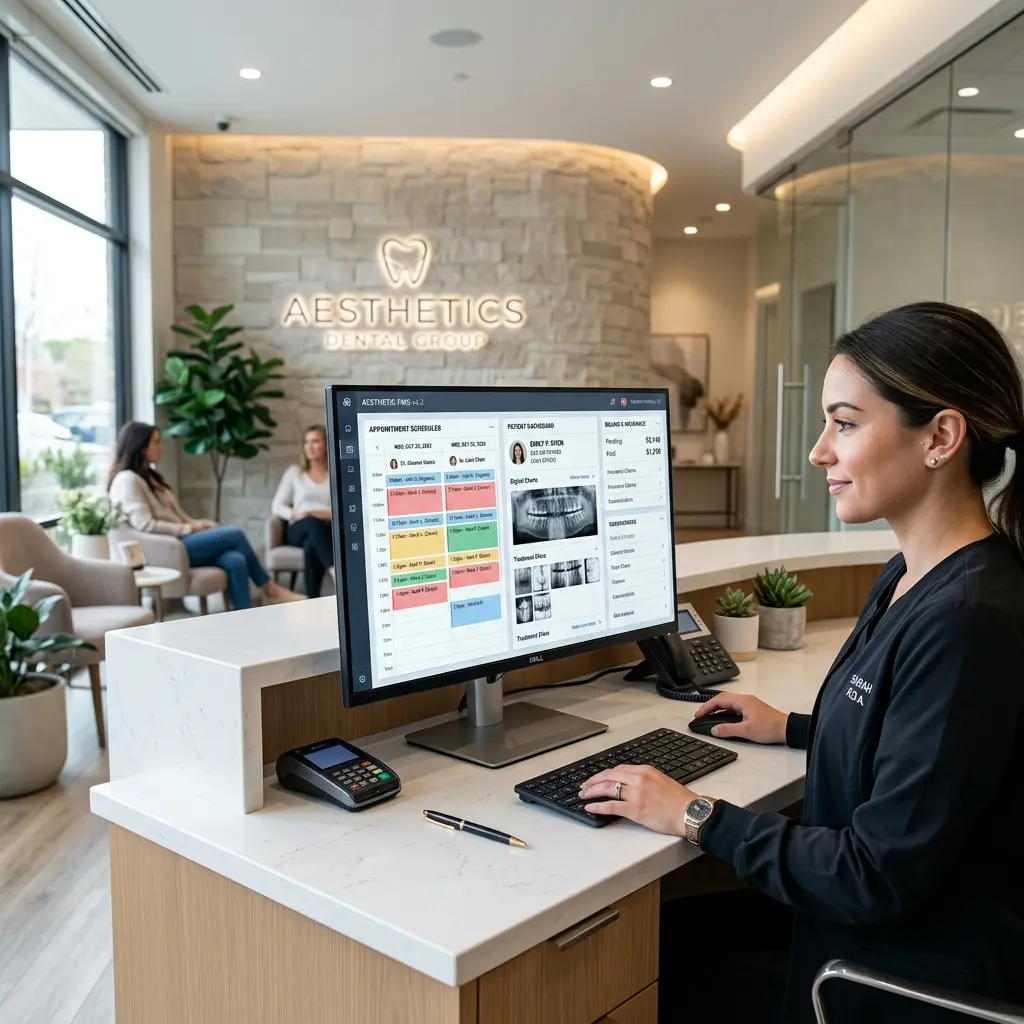
Dental practice management software (PMS) is the central system a dental practice uses to manage scheduling, charting, billing, imaging, and patient records. The best PMS in 2026 combines a reliable clinical and administrative core with an open architecture that lets AI tools (voice receptionists, clinical documentation, automated recall) integrate directly. The platform choice matters less than how well it connects to the tools that drive scheduling and revenue.
Dental practice management software is the operating system of a dental practice. It holds the schedule, the charts, the ledger, the imaging, and the patient history. Choosing it is one of the highest-stakes operational decisions a practice owner makes, because switching later is painful.
The good news in 2026 is that the core functionality across the major platforms is mature and reliable. The real differentiator now is openness: how easily the PMS connects to the AI tools and automation layers that actually move scheduling and revenue. Here is how to evaluate that.
What does dental practice management software actually do?
A modern PMS handles five core functions: appointment scheduling, clinical charting, billing and insurance, imaging integration, and patient record management. Everything else a practice runs on layers on top of those five.
What separates platforms is not whether they do these things, but how well they do them and how openly they let other systems connect. That second point is where the 2026 decision really lives.
Should I choose cloud-based or server-based dental software?
Cloud-based dental practice management software has become the default for new practices and most relocations. It removes the on-site server, handles backups automatically, and makes multi-location access straightforward.
Server-based systems still have a place, particularly for established single-location practices with reliable infrastructure and a preference for local control. The trend, though, is clearly toward cloud, and the AI integration ecosystem is increasingly built cloud-first.
How important is open architecture and integration?
It is the single most important criterion in 2026. A PMS that connects openly to third-party tools lets you add a voice AI receptionist, automated insurance verification, AI clinical documentation, and recall automation without ripping anything out.
Open Dental has become a reference point here because its open architecture supports deep integration. Other major systems such as Dentrix and Eaglesoft integrate as well, with varying depth. The question to ask any vendor is specific: can third-party tools read from and write to the schedule and patient record in real time?
What AI capabilities should a PMS support in 2026?
The PMS itself does not need to be the AI. It needs to support the AI tools that sit on top of it.
- Voice AI receptionist that books directly into the schedule
- Automated insurance eligibility verification
- AI clinical documentation that writes notes into the chart
- Automated recall and reactivation outreach
- Real-time practice analytics and reporting
What does dental practice management software cost?
Pricing ranges widely based on cloud versus server, number of providers, and bundled features. Cloud platforms typically price per provider per month. Server systems often involve a larger upfront license plus support contracts.
The more useful budgeting question is total cost of the stack: the PMS plus the AI and automation tools that run on it. A modest PMS paired with strong automation usually outperforms an expensive all-in-one with weak integration.
Frequently Asked Questions
See the AI Dental Receptionist in action
Book a 20-minute demo and watch it answer calls, book appointments, and run reactivation campaigns inside your practice management software.
Book Your Free Demopatientxpress.us | 949-542-6773