Quick Answer
Dental front desk software encompasses the tools that run the front office: call handling, scheduling, reminders, insurance verification, and payments. The modern version automates most of this, with an AI receptionist answering calls and booking, automated reminders and recall, automated verification, and integrated payments. Rather than a single program, dental front desk software is now a connected stack of automation that handles routine front office work and frees staff for higher-value tasks.
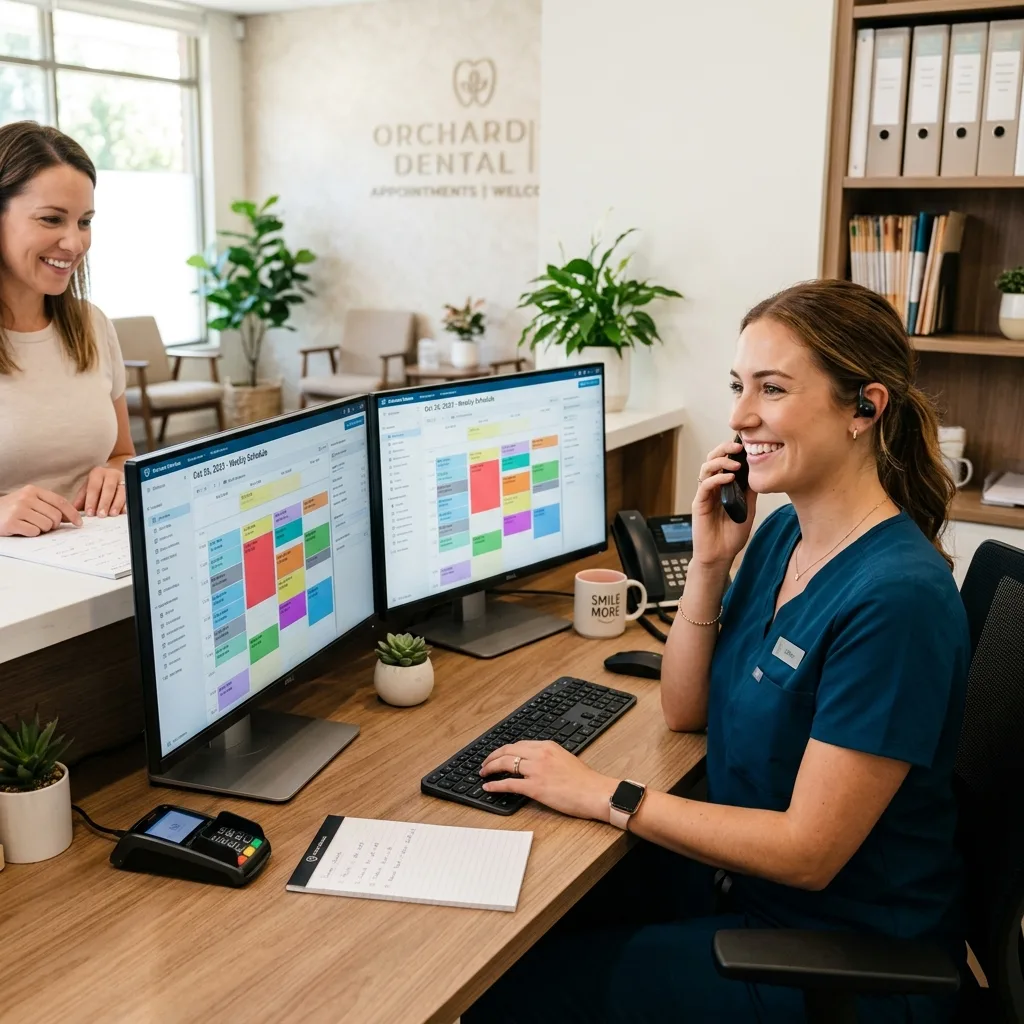
The dental front desk is the busiest, most interrupt-driven spot in the practice. Phones, scheduling, check-in, checkout, insurance, payments, and patient questions all converge there, usually on too few people.
Dental front desk software has evolved from a single scheduling program into a connected stack of automation that handles most of that load. Here is what the modern front office actually runs on.
What does dental front desk software include today?
It is no longer one program. The modern front desk runs on a connected set of tools, each automating part of the workload.
- AI receptionist for answering calls and booking
- Scheduling and online self-booking
- Automated reminders, confirmations, and recall
- Insurance eligibility verification
- Integrated payment processing and text-to-pay
- Patient communication across text, voice, and email
Why has the front desk become a bottleneck?
The front desk has a fixed number of people and hours, but the workload is elastic and constant. Calls come in faster than they can be answered. Reminders and recall pile up. Verification eats hours. Something always gives, and usually it is the proactive work like recall and cancellation backfill.
That bottleneck caps growth. A practice can only book as many appointments as the front desk can field, which is why automation that lifts the routine load has such a large effect.
How does automation transform the front office?
Automation absorbs the high-volume repetitive work. The AI Dental Receptionist answers every call and books directly, around the clock. Reminders, recall, and reactivation run themselves. Verification happens in the background. Payments process and post automatically.
What remains for the team is the work that genuinely needs a person: greeting patients, handling complex situations, supporting the clinical team, and building relationships. The front desk stops being a switchboard and becomes a patient experience role.
What should a modern front desk stack prioritize?
Integration is the foundation. Every tool should connect to the practice management software so data flows without re-entry. After that, prioritize the highest-volume pain point first, which for most practices is the phone.
Adding an AI receptionist usually delivers the fastest, most visible relief, because the phone is the biggest single drain on front desk time. From there, layer in automated recall, verification, and payments.
Does automating the front desk mean fewer staff?
It means a different front desk, not necessarily a smaller one, though some practices do run leaner. The team shifts from reactive task-juggling to proactive patient care and complex problem-solving.
The goal is not an empty front desk. It is a front desk that is not drowning, doing work that matters, while automation handles the repetitive volume that used to consume the day.
Frequently Asked Questions
See the AI Dental Receptionist in action
Book a 20-minute demo and watch it answer calls, book appointments, and run reactivation campaigns inside your practice management software.
Book Your Free Demopatientxpress.us | 949-542-6773