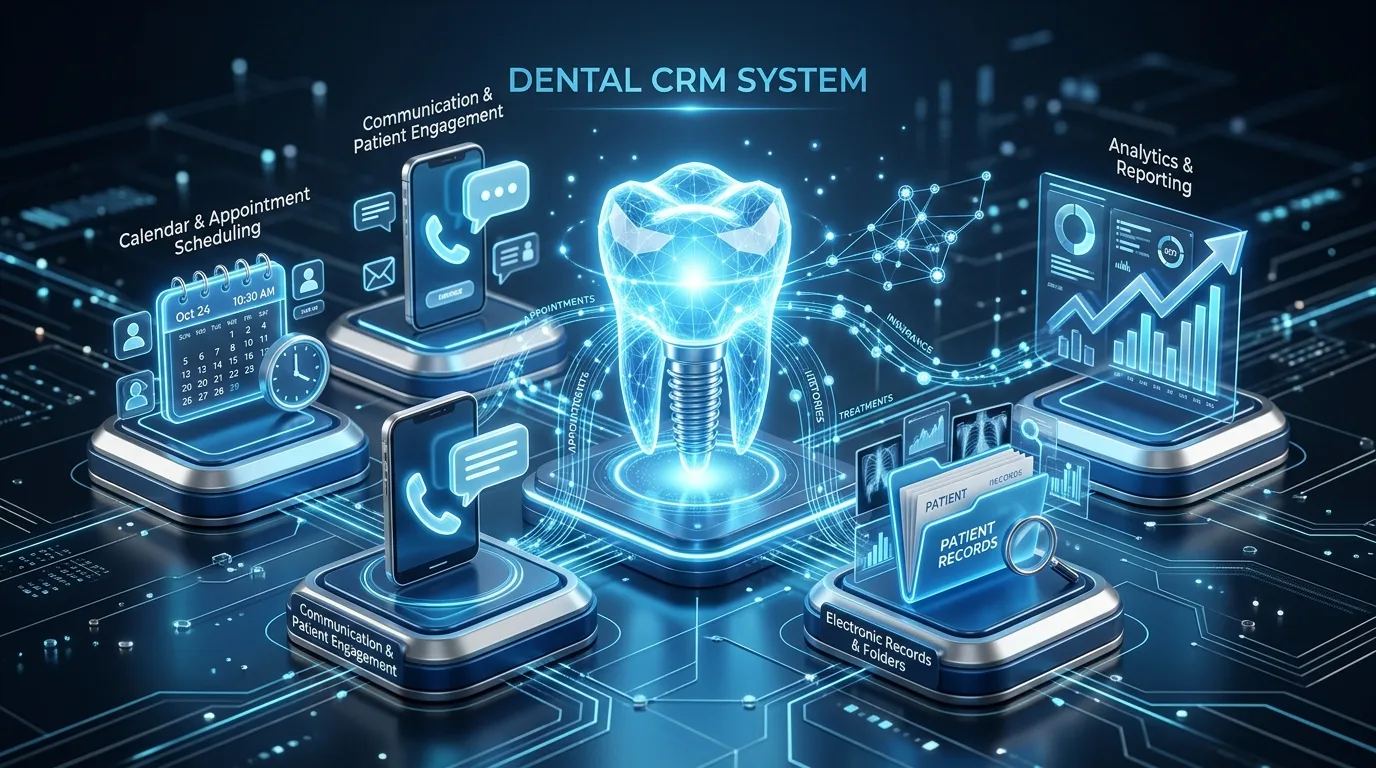
AI Generated Graphic
Quick Answer
A dental CRM is software that manages relationships with patients and prospective patients: tracking inquiries, following up on leads, and keeping communication organized from first contact through ongoing care. Many practices do not need a standalone CRM, because a well-integrated practice platform can handle lead tracking, communication, and follow up inside the system the team already uses.
What does a CRM do in a dental practice?
CRM stands for customer relationship management, and in dentistry the customer is the patient. A dental CRM keeps track of every interaction a person has with your practice: the first phone call, the website inquiry, the appointment history, the outstanding treatment plan, and the follow up that has or has not happened. The goal is that nobody who expresses interest in your practice quietly disappears because their record lived in someone's memory or a sticky note.
In practical terms, a CRM answers questions your front desk gets asked and questions your owner should be asking. Who called last week and never booked? Which patients have unscheduled treatment? How many new patient inquiries came from the website this month, and how many of them turned into appointments? Without a system, those answers take a hunting expedition. With one, they take a report.
How is a dental CRM different from practice management software?
Practice management software runs the clinical and operational core of the practice: the schedule, the charts, the claims, the ledger. A CRM concentrates on the relationship layer that sits in front of and around that core, especially the stretch between someone hearing about your practice and becoming an active patient.
The line between the two has blurred, and that is mostly good news for practices. Modern platforms increasingly bring CRM functions like lead tracking, automated follow up, and communication history into the same environment as the schedule and the chart. When those functions live where your team already works, they actually get used, which is the part most standalone CRM projects get wrong.
When does a standalone dental CRM make sense?
A separate CRM earns its keep in a few situations. Multi-location groups running centralized call centers often need pipeline tooling that goes beyond what any single practice system provides. Practices spending heavily on advertising sometimes want granular attribution across campaigns. And startups building a patient base from zero may want structured lead nurture before there is much of a schedule to manage.
For most established practices, though, a standalone CRM adds a second system to log into, a second place data can go stale, and a monthly bill for features that overlap what an integrated platform already does. The honest question is not whether a CRM would help. It is whether the CRM functions you need can run inside the system your team already lives in.
What does an integrated approach look like?
PatientXpress takes the integrated path. Because the platform is built natively on Open Dental, patient records, appointments, and communication all live against the same live database. When the AI Dental Receptionist answers a call from a prospective patient, the inquiry is captured, the appointment is booked directly onto the schedule, and the record exists in the same system your team uses all day. Nothing needs to be re-entered into a separate relationship tool, and nothing waits on a sync.
For practices on Dentrix, Eaglesoft, and other systems, the same functions connect through Kolla with broad support across the market. Either way, the relationship layer runs where the work happens, which is what makes it stick.
What data should live in the relationship record?
A useful CRM record answers the next conversation before it starts. That means contact preferences and consent, so the practice knows this patient answers texts but never voicemail. Source, so you know the patient came from the Google listing, a referral, or the insurance directory, which is the raw material of every marketing decision you will make later. Communication history across every channel, complete enough that any team member can pick up any thread. And status flags that matter operationally: recall due date, unscheduled treatment, outstanding balance, active payment plan.
What should not live there is duplication. If the CRM keeps its own copy of appointment history or insurance details that also live in the practice management system, the two copies will disagree within a month, and the team will learn to trust neither. The record should reference the operational data, not replicate it, which is precisely what an integrated platform makes possible and a bolted-on CRM makes impossible.
What does CRM discipline look like week to week?
Systems only produce what routines harvest, so the practices that get value from relationship data run a short weekly rhythm around it. Monday: review new inquiries from the prior week and confirm every one got a response and a next step. Midweek: work the unscheduled treatment list, oldest acceptances first, since those decay fastest. Friday: glance at the pipeline numbers, inquiries in, appointments booked, and where the drop-off happened.
The whole rhythm takes under an hour when the data assembles itself, which is the real dividing line between CRM setups. If preparing the Monday review takes forty minutes of report-pulling, the review dies by October. If it takes one screen, it survives indefinitely, and the compound interest of never dropping an inquiry starts accruing.
Frequently Asked Questions
See the AI Dental Receptionist in action
Book a 20-minute demo and watch it answer calls, book appointments, and run reactivation campaigns inside your practice management software.
Book Your Free Demopatientxpress.us | 949-542-6773