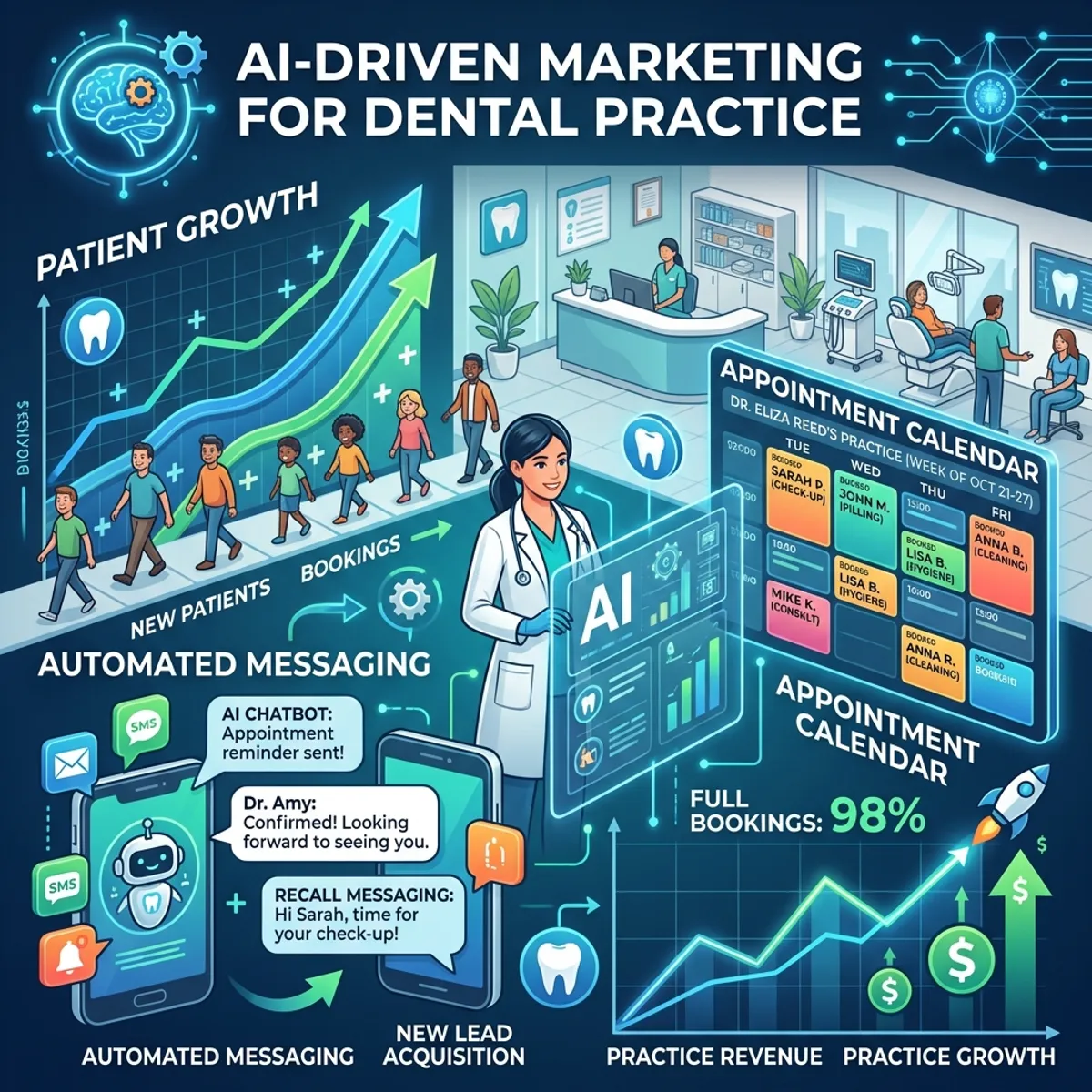
AI Generated Graphic
Quick Answer
AI call handling gives dental clinics what call centers promised without the tradeoffs: every call answered immediately, appointments booked directly into the live schedule, full documentation of every conversation, and consistent handling at any volume. Unlike an outsourced call center, the AI works inside the practice's own systems and never takes a message it could have resolved.
Why did dental groups turn to call centers, and what did it cost?
Call centers solved a real problem: phones ringing past what front desks could answer. Centralizing calls bought coverage and consistency, especially for multi-location groups. But it bought them at a price familiar to anyone who has run one: agents working from scripts without schedule access taking messages instead of booking, patients repeating themselves, staffing costs that scale linearly with volume, and quality that varies with turnover.
The structural flaw was distance. The call center sat outside the practice's systems, so the thing most callers wanted, a confirmed appointment, was often exactly what the agent could not deliver.
What does AI call handling do differently?
It collapses the distance. The AI Dental Receptionist answers inside the practice's own environment, reading the live schedule during the call and writing bookings directly to it. There is no message-taking layer, no callback queue, and no handoff where context gets dropped. Every call is answered on the first ring regardless of how many arrive simultaneously, which no staffing model can economically match.
Documentation improves in the same motion. Every conversation is captured and transcribed, so what was said, promised, and booked is on the record rather than in an agent's summary field.
Does this apply to single practices or just groups?
Both, and arguably single practices gain more. A group considering a call center at least has scale to spread the cost over. A single practice never could justify one, so its overflow simply went to voicemail. AI call handling gives that practice the coverage of a call center at software cost, with better outcomes because the bookings are real.
For groups, the model changes the growth math: locations can be added without linearly adding phone staff, and every location gets identical call quality from day one.
What should clinics evaluate in an AI call solution?
Integration depth first: does it book against your live practice management schedule, or take structured messages? PatientXpress books natively on Open Dental and connects to Dentrix, Eaglesoft, and other systems through Kolla, which is the standard to hold any product to. Then handling quality: listen to real calls, not demo reels. Then the practical envelope: after-hours behavior, emergency routing per your protocol, and how the AI hands off the calls that genuinely need a human.
The right solution should feel less like hiring a call center and more like the phones simply stopped being a constraint.
What does concurrency actually mean for a practice's phones?
The lunch-hour math explains most missed calls. A practice receiving six calls in a ten-minute window with two people at the desk, both mid-task, physically cannot answer them all, and no realistic staffing fixes a problem that arrives in bursts. Voicemail absorbs the overflow, and overflow is precisely when demand is highest, since the same triggers, a running ad, a school holiday, a Monday morning, that spike your calls spike everyone's availability to make them.
Concurrency is the property that dissolves the math: every simultaneous call answered simultaneously, the sixth caller greeted as promptly as the first. It is not a staffing level, it is an architecture, and it is the single capability human models cannot buy at any reasonable price.
How do handoff rules keep humans in the right conversations?
The design question is not whether humans stay involved but which conversations get them. Practices define the routing: clinical questions beyond approved scope, distressed or upset callers, complex financial negotiations, and anything the AI recognizes as needing judgment transfer to staff with the context attached, during hours, or route per protocol after them. Everything routine, booking, rescheduling, hours, directions, insurance participation, forms, resolves without consuming a human minute.
Well-tuned rules produce a distinctive daily texture: the desk's phone conversations are fewer and heavier, each one a situation that genuinely benefits from a person, while the light traffic flows around them continuously. Teams describe it as finally doing the job as imagined, which is the honest measure of automation done right.
Frequently Asked Questions
See the AI Dental Receptionist in action
Book a 20-minute demo and watch it answer calls, book appointments, and run reactivation campaigns inside your practice management software.
Book Your Free Demopatientxpress.us | 949-542-6773