Quick Answer
A dental practice that misses 30 percent of its incoming calls loses far more than the appointments those calls represented. Missed calls drive patients to competitors, suppress new patient acquisition, increase the workload on the front desk through voicemail backlog, and create a negative feedback loop where overwhelmed staff miss even more calls. Over 12 months, the cumulative revenue impact can exceed $100,000 for a single-provider practice.
Every dental practice knows it misses calls. What most do not realize is how far the impact extends beyond the obvious.
A missed call is not a neutral event. It is an active negative. The patient who did not get through does not simply wait. They form an impression. They make a decision. And in most cases, that decision works against the practice.
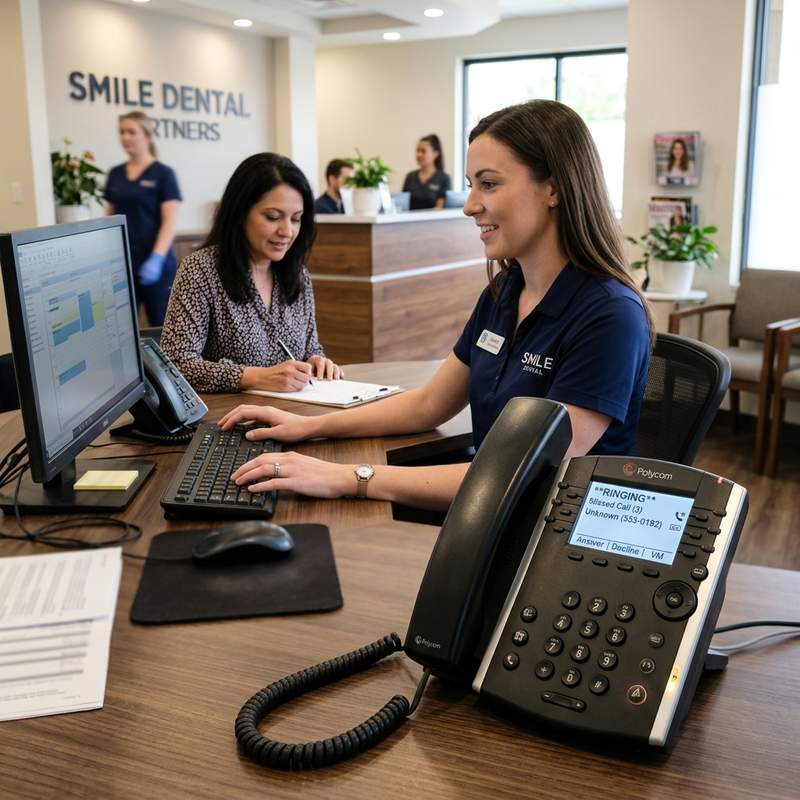
A ringing phone that goes unanswered is more than a missed connection—it's a missed revenue opportunity.
What Happens Immediately When a Call Goes Unanswered?
The patient hears ringing that nobody picks up, or they reach voicemail. Research on healthcare consumer behavior consistently shows that more than 75 percent of patients who reach voicemail hang up without leaving a message. They are not angry. They are simply moving on to the next option.
For a prospective new patient, that missed call is often the only interaction they will ever have with the practice. Their entire impression is based on the fact that nobody answered. They call another office, someone picks up, and the appointment is booked there instead.
How Does a 30 Percent Miss Rate Affect New Patient Acquisition?
New patient calls are the highest-value calls a dental practice receives. Each one represents a potential relationship worth $500 to $700 in first-year revenue and over $1,200 over the lifetime of the patient. When 30 percent of incoming calls go unanswered, a meaningful portion of those are new patient inquiries that never convert.
A practice receiving 60 calls per day with a 30 percent miss rate is failing to answer 18 calls daily. If even one-third of those are new patient opportunities, that is six potential patients lost every day. Thirty per week. Over 1,500 per year. The math is painful.
What Happens to Existing Patient Relationships?
Existing patients are more forgiving than new ones, but their patience has limits. A patient who calls to reschedule and cannot get through may try again. Or they may not. A patient who needs to confirm insurance coverage and reaches voicemail will call the insurance company directly and get their answer, but the experience with the practice was negative.
Over time, patients who consistently struggle to reach the office start looking for alternatives. They do not announce they are leaving. They simply book their next appointment somewhere else. The practice sees a gradual decline in retention and attributes it to competition or market conditions when the real cause is accessibility.
How Does the Voicemail Backlog Compound the Problem?
Every missed call that does result in a voicemail creates work for the next day. The front desk arrives in the morning with a list of callbacks to make before the day's patients start arriving. Those callbacks compete with incoming calls, check-ins, and every other front desk task. Some get returned. Some get pushed to the afternoon. Some never get returned at all.
The voicemail backlog does not just cost time. It creates a cycle. The more time the front desk spends returning yesterday's calls, the less available they are to answer today's calls. The miss rate stays high because the team is always catching up instead of staying ahead.
What Is the Financial Impact Over 12 Months?
The direct revenue loss from missed new patient calls alone can exceed $100,000 annually for a single-provider practice. Add in the lost revenue from existing patients who quietly leave, the reduced production from unfilled cancellation slots, and the overhead cost of staff time spent on voicemail triage, and the total impact grows significantly.
These are not theoretical projections. They are the natural outcome of a communication system that cannot keep up with patient demand. The practice is not failing clinically. It is failing at the phone. And the phone is where the revenue starts.
How Does an AI Dental Receptionist Change This?
An AI dental receptionist eliminates missed calls entirely. Every inbound call is answered instantly, regardless of time of day, call volume, or front desk availability. Appointments are booked in real time. Questions are answered. Follow-ups are handled automatically.
The voicemail backlog disappears because there are no voicemails. The callback list disappears because every call is handled when it comes in. The front desk team focuses on the patients in the building instead of racing to return calls from yesterday.
Practices that implement an AI dental receptionist typically see their effective call answer rate jump from 70 percent to near 100 percent. The revenue that was leaking out through missed calls starts showing up on the schedule immediately.
Stop Missing Calls. Start Filling Chairs.
Book a free demo and we will walk you through exactly how the AI Dental Receptionist works inside your practice. No pressure. Just a real look at what it can do for your team.
Book Your Free DemoQuestions first? Call us at (949) 542-6773 or visit www.patientxpress.us