Key Takeaways
- Between February and April, dental practices face a double revenue
hit — lower patient volume AND compounding operational
inefficiencies.
- A single missed new patient call can represent $800–$1,200 in
lost first-year production.
- Just 5 missed calls per week can translate to
$200,000+ in lost annual revenue.
- The most profitable practices eliminate friction across every step of the
patient lifecycle through full PMS integration.
- When tools live directly inside your PMS, your books are cleaner and your
revenue cycle data tells a coherent story at tax time.
Every year between February and April, dental practice owners face a painful double
whammy. On one hand, they're scrambling to get their own books in order, reconcile
accounts, and work with CPAs.
On the other, patient volume tends to dip because people delay elective procedures when
they're anxious about finances. But here's what most practice owners don't realize:
the revenue you lose during tax season isn't just from fewer patients walking in
the door.
$200K+
Annual revenue lost from just 5 missed calls per week
35%
Of insurance claims denied due to data-entry errors across
platforms
9+ hrs
Per week wasted on manual insurance verification at the
front desk
The Hidden Cost of Tax Season for Dental Practices
It's from the operational inefficiencies that have been bleeding you dry all
year. Those inefficiencies become impossible to ignore when your accountant
starts asking hard questions.
The painful irony is that tax season — when you're most distracted — is exactly when
these leaks accelerate. Your front desk is fielding panicked insurance questions. Your
billing team is buried in end-of-year reconciliations. And meanwhile, the phone keeps
ringing.
Here's the real story: The revenue you lose during tax season was never
going to show up on a report. It's invisible — missed calls that never became
appointments, claims that silently failed, and patients who booked with a competitor who
answered faster.
Where Is the Money Actually Going?
Take a hard look at your overhead. How many hours per week does your front desk spend on
the phone verifying insurance eligibility? How many claims get denied
because of data-entry errors between your practice management system and a separate
billing platform? How many patients never schedule because their call went to voicemail
during lunch?
These aren't minor annoyances. They're profit killers hiding in plain sight.
Missed Call Revenue Leak
-
$800–$1,200 lost per missed new patient call
-
5 missed calls/week = $200K+ annual loss
-
Voicemail callers move to a competitor immediately
-
Never captured in any practice report
Billing & Insurance Friction
-
Claim denials from manual data re-entry errors
-
9+ hrs/week on insurance eligibility calls
-
Separate platforms = duplicate errors, gaps in data
-
Write-offs that could have been avoided with automation
Estimated annual revenue loss — just from missed calls
$200,000+
5 missed calls/week × $800 avg. new patient value × 52 weeks — silently walking out
the door.
Now imagine sitting down with your CPA and being able to point to exactly how you
plugged those leaks.
The Case for a Fully Integrated PMS Solution
The most profitable dental practices aren't the ones that simply see the most patients.
They're the ones that eliminate friction from every step of the patient
lifecycle. That means payment processing, insurance verification, patient
communication, forms, and scheduling all happening in one place — directly inside your
practice management software.
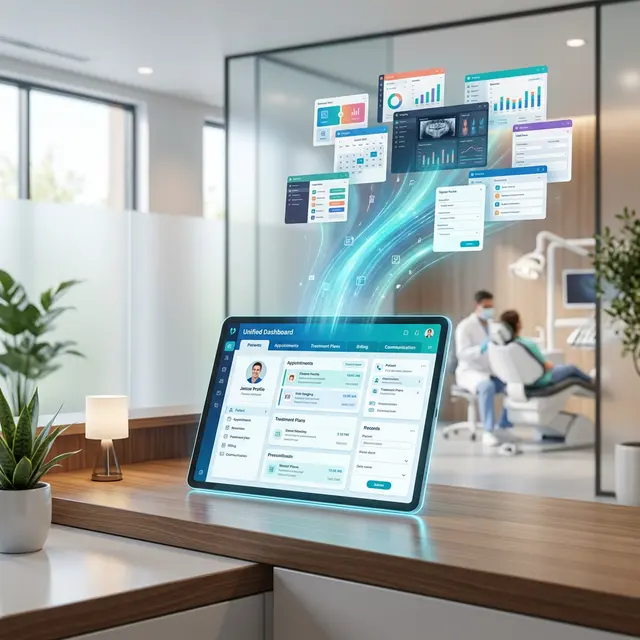
When your tools live inside Open Dental (or your PMS of choice),
there's no toggling between platforms. No re-keying data. No wondering if a claim was
actually submitted. Everything your front office needs is right where they already work.
And when tax time comes? Your books are cleaner, your write-offs are documented, and
your revenue cycle data actually tells a coherent story.
What Integration Fixes
-
Zero data re-entry between billing and scheduling
-
Real-time insurance verification, in-workflow
-
Automated claim submission with error checks
-
Every interaction logged, auditable at tax time
What Cleaner Books Look Like
-
Coherent revenue cycle data for your CPA
-
Documented write-offs with clear reasoning
-
Fewer surprise denials at end-of-quarter
-
Tax season prep that takes hours, not weeks
What You Can Do Right Now
If tax season has you stressed, use that energy productively. Audit your current
tech stack. Count how many separate tools your team logs into every day.
Ask your front desk how many calls go to voicemail. Look at your claim denial rate.
-
Count your tools. How many platforms does your front desk log
into daily? Each one is a friction point and a potential error source.
-
Pull your missed call data. Most phone systems have this
report. The number will likely surprise you — and it's directly tied to lost
revenue.
-
Check your denial rate. A denial rate above 5% is a sign of
systemic billing friction — usually caused by platform-hopping and manual
re-entry.
-
Time your insurance verification. Ask your front desk to
track it for one week. The hours add up to real dollars every quarter.
Then ask yourself: what would it mean for your bottom line if all of those
problems simply went away?
The PatientXpress Difference
PatientXpress is built specifically to eliminate this kind of friction from inside your
PMS. You don't need a separate platform for payments, a different tool for insurance
verification, and a third system for patient communication. It all lives where your team
already works.
-
AI-powered call answering — every inbound call gets handled,
even during lunch and after hours.
-
Real-time insurance verification — directly inside Open
Dental, no tab-switching required.
-
Integrated payment processing — no separate terminals, no
reconciliation headaches at month-end.
-
Automated patient communication — confirmations, reminders,
and follow-ups that run without your team lifting a finger.
-
Clean, auditable records — so your CPA gets data that tells a
coherent story, every tax season.
The Bottom Line
The answer might be the best tax-season news you've gotten all year. Tax season will
always bring some friction. But the practices that thrive through it are the ones that
have already closed the operational gaps that compound pressure into
crisis.
If you've never sat down and calculated what your missed calls, denied claims, and
manual processes are actually costing you — do it this week. The number will be
uncomfortable. And it will be exactly the motivation you need to finally fix it.
Frequently Asked Questions
During tax season (February–April), patient volume dips as people delay
elective procedures due to financial anxiety. Simultaneously, practice
owners are distracted by bookkeeping and CPA meetings, letting operational
inefficiencies go unchecked — missed calls, claim denials, and manual
insurance verification compound into significant revenue loss.
A single missed call from a new patient can represent $800 to $1,200
in lost first-year production. Across just five missed calls a
week, a practice could lose $200,000 or more in annual revenue — a number
that never appears on any standard practice report.
A fully integrated PMS (Practice Management Software) solution means
payment processing, insurance verification, patient communication,
forms, and scheduling all happen in one place — directly inside
your practice management software like Open Dental. No toggling between
platforms, no re-keying data, and no question about whether a claim was
actually submitted.
PatientXpress integrates AI-powered patient communication, automated
insurance verification, and missed-call recovery directly into
your PMS. This eliminates data-entry errors, ensures no call goes
unanswered, and keeps your revenue cycle running cleanly — so your books
tell a coherent story at tax time.
Ready to Close the Revenue Leaks Before Next Tax Season?
See exactly how PatientXpress eliminates friction from your practice — and what
that's worth for your specific numbers.
Book a Free Demo