Quick Answer
The reason most dental practices have a lower star rating than they deserve is not that patients are unhappy. It is that happy patients do not leave reviews on their own. Frustrated patients are motivated by emotion to post. Satisfied patients walk out the door, go about their day, and forget. Automated review solicitation fixes this by sending a review request at the right moment, while the positive experience is still fresh, making it easy for happy patients to share their experience with one tap.
One dental practice set a goal at the beginning of the year: 300 five-star Google reviews in 12 months. The whole team committed to delivering an exceptional patient experience at every appointment. And they used automated review outreach through PatientXpress to make sure the patients who had those great experiences actually left a review.
They hit the goal. The entire staff earned an all-expenses-paid trip overseas as the reward.
That result is not typical. But it is not a fluke either. It is what happens when a practice combines genuine patient care with a system that consistently asks for feedback at the right time.
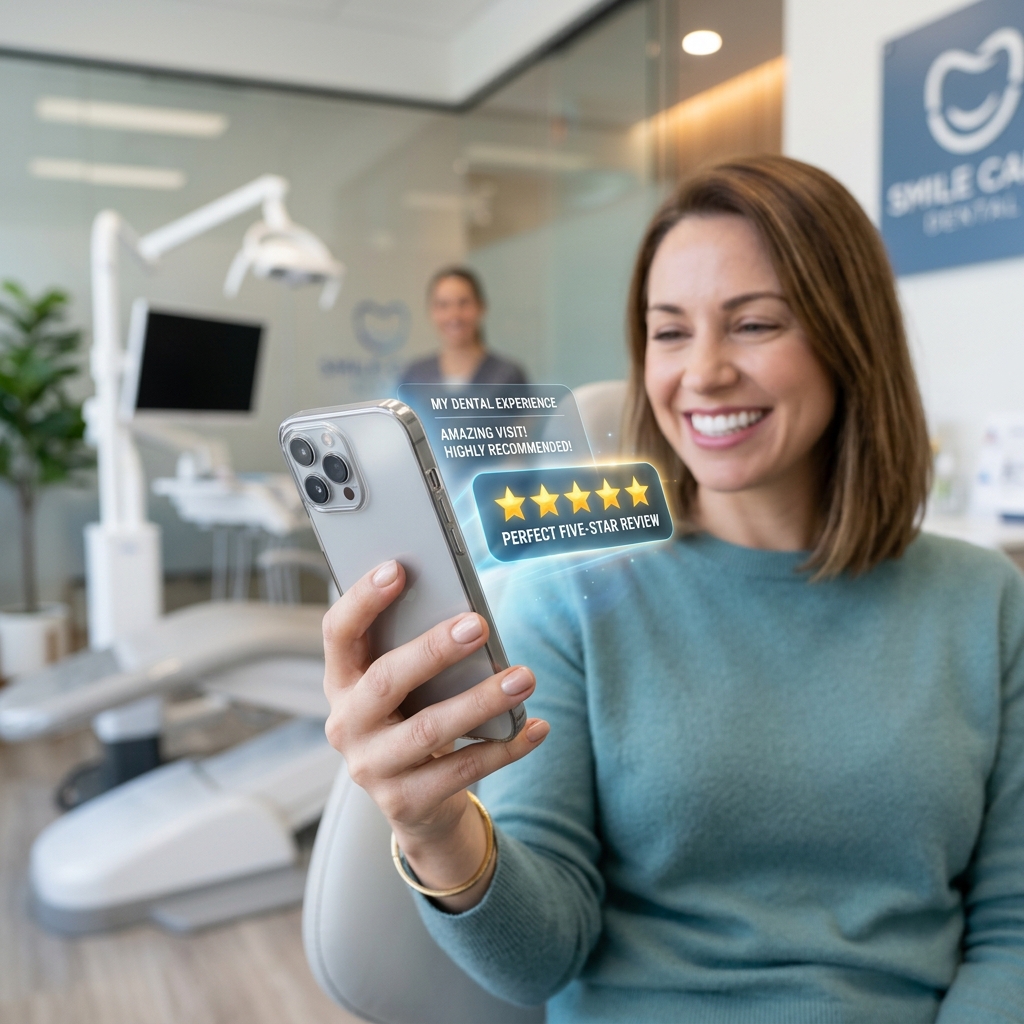
Automated outreach taps into the positive experiences your team is already delivering.
Why Don't Happy Patients Leave Reviews on Their Own?
The psychology is straightforward. When a patient has a good dental visit, they leave feeling relieved and move on with their day. The experience was positive, but it was not emotionally charged enough to drive them to open Google, search for the practice, and write a review. Good experiences feel normal. People do not feel compelled to document normal.
Negative experiences are different. A long wait, a billing surprise, a rude interaction. These create frustration, and frustration is a powerful motivator. The patient who felt mistreated will go out of their way to post about it. The patient who had a perfectly smooth visit will not.
This creates a natural imbalance. Without any intervention, a practice's online reputation skews negative relative to the actual quality of care being delivered. It is not that the practice is bad. It is that the good experiences are invisible.
What Is the Review Gap and Why Does It Matter?
The review gap is the difference between how patients actually feel about a practice and what the online reviews reflect. Most dental practices have a review gap that works against them. Their satisfied patients outnumber their dissatisfied ones by a wide margin, but the online profile does not show it.
This matters because prospective patients make decisions based on what they see online. A practice with 4.2 stars and 40 reviews looks less trustworthy than a practice with 4.9 stars and 300 reviews, even if the first practice delivers better care. Volume and recency of reviews signal credibility. A thin review profile signals uncertainty.
How Does Automated Review Solicitation Work?
Automated review solicitation sends a personalized review request to each patient after their appointment. The timing, channel, and message are all configured to maximize the likelihood that the patient follows through.
Timing matters. A review request sent two hours after an appointment gets a significantly higher response rate than one sent the next day. The experience is still fresh. The patient remembers the friendly hygienist, the short wait, the smooth checkout. By tomorrow, it is just another errand they forgot about.
Simplicity matters. The review request should take the patient directly to the Google review page with one tap. Every extra step between the request and the review is a drop-off point. If the patient has to search for the practice, find the review section, and figure out how to post, most of them will not bother.
Consistency matters. One review request after one visit is easy to ignore. A practice that asks every patient after every visit builds a steady stream of reviews that compounds over time. That consistency is what took one practice from zero to 300 five-star reviews in a single year.
How Do You Make Sure the Happy Patients Are the Ones Reviewing?
This is the question every practice owner asks, and the answer is built into how a smart review automation system works.
The first step is a satisfaction check before the review request. After the appointment, the system sends a brief message asking the patient about their experience. If the patient indicates they had a great visit, they are directed to leave a Google review. If the patient indicates something went wrong, they are routed to a private feedback channel where the practice can address the concern directly.
This is not about suppressing negative feedback. It is about giving unhappy patients a direct line to the practice instead of sending them to a public platform where the issue cannot be resolved. The patient gets heard. The practice gets a chance to fix the problem. And the public review profile reflects the genuine experience of patients who were happy with their care.
What Did This Look Like for the Practice That Hit 300 Reviews?
The practice that achieved 300 five-star reviews in 12 months did not do anything exotic. They focused on two things: delivering a consistently great patient experience and making sure every patient was asked for a review after every visit.
The team focused on the human side. Warm greetings. Minimal wait times. Clear communication about treatment. A checkout process that felt easy instead of rushed. Every touchpoint was intentional.
PatientXpress Automations handled the follow-up. After each appointment, the system sent a review request automatically. Patients who had a great experience were guided to Google. Patients who had concerns were routed to the practice directly. The front desk did not have to remember to ask, did not have to chase patients down, and did not have to manage the process manually.
The result was a steady accumulation of authentic five-star reviews from real patients who genuinely had a positive experience. By the end of the year, the practice had 300 of them. And the team earned their trip.
What Are the Most Common Mistakes Practices Make With Review Generation?
Asking in person at checkout. This puts the front desk in an awkward position and puts social pressure on the patient. Some will say yes and never follow through. Others will feel uncomfortable being asked. Automated outreach after the visit removes the awkwardness and lets the patient respond on their own time.
Asking once and stopping. A single review campaign or a one-time push generates a temporary spike and then flatlines. Consistent automated requests after every appointment build a review profile that grows steadily month over month.
Making it complicated. If the patient has to click through multiple screens, log into a Google account, or figure out where to leave the review, they will not do it. The request needs to go straight to the review page with one tap.
Ignoring negative feedback. Practices that do not have a private feedback channel end up with negative reviews that could have been resolved behind the scenes. A satisfaction check before the review request gives the practice a chance to address problems before they become public.
Waiting too long. A review request sent three days after the appointment is too late. The emotional connection to the experience has faded. Same-day outreach, ideally within a few hours of the visit, gets the best results.
How Many Reviews Should a Dental Practice Aim For?
There is no universal number, but the practices that consistently attract new patients online tend to have at least 100 to 150 Google reviews with an average rating above 4.7 stars. Beyond that threshold, additional reviews continue to build credibility and improve local search ranking.
The pace matters too. Google's algorithm favors practices that receive reviews consistently over time rather than in bursts. A practice that gets 5 to 10 new reviews per month signals ongoing patient satisfaction. A practice that got 50 reviews two years ago and nothing since signals stagnation.
The practice that hit 300 averaged roughly 25 new reviews per month, sustained across 12 months. That pace is achievable for any practice with consistent patient volume and automated review outreach in place.
Does a Stronger Review Profile Actually Affect Practice Revenue?
Yes, and the effect is measurable. Practices with higher star ratings and more reviews appear higher in Google's local search results, which means more visibility to prospective patients who are actively looking for a dentist. Higher visibility leads to more website visits, more calls, and more new patient appointments.
Beyond search ranking, reviews serve as social proof. A prospective patient comparing two practices will almost always choose the one with more positive reviews, even if the other practice is closer or slightly cheaper. Reviews reduce the perceived risk of choosing a new provider. They answer the question every new patient is really asking: will I be treated well here?
Ready to Turn Happy Patients Into Five-Star Reviews?
Book a free demo and we will show you exactly how PatientXpress Automations help practices generate consistent five-star reviews without adding a single task to your front desk team's plate.
Book Your Free DemoQuestions first? Call us at (949) 542-6773 or visit www.patientxpress.us