Quick Answer
Dictation software transcribes what the provider says into text. The provider still has to narrate the note separately, usually after the patient leaves. AI clinical notes listen to the natural clinical conversation during the appointment and generate a structured note automatically. The provider does not dictate anything. The documentation happens in the background while the provider focuses on patient care.
Dictation software has been available in healthcare for decades. It is faster than typing, and for many providers it was a meaningful improvement over manual charting. But it still requires the provider to do the work of creating the note. The software just changes the input method from keyboard to voice.
AI clinical notes take a fundamentally different approach. Here is how the two compare in actual clinical use.
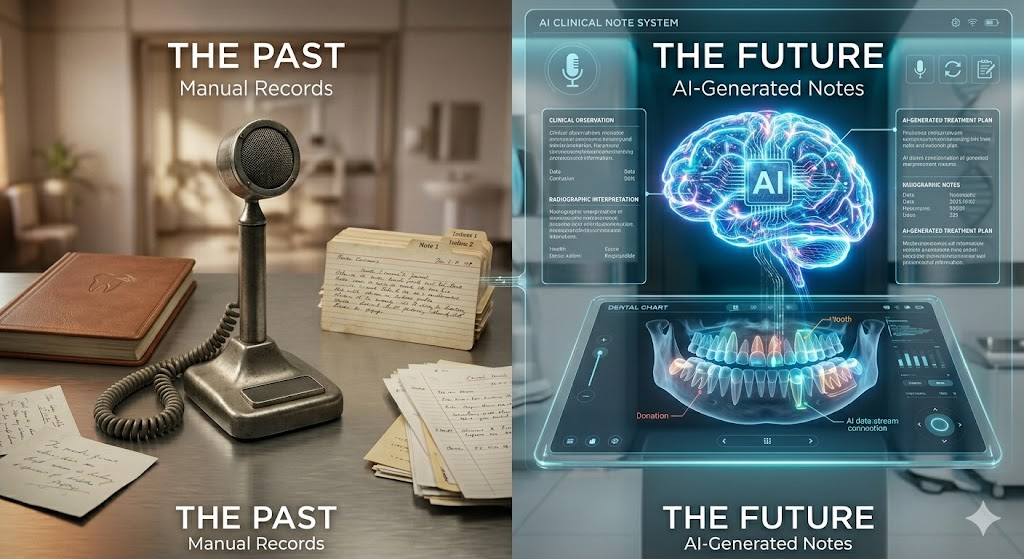
Modern AI listens to conversations naturally, while dictation requires manual narration commands.
Does the Provider Have to Narrate the Note?
Dictation software: Yes. After the patient leaves, the provider sits down and dictates the note from memory. The software converts their speech to text. The provider then reviews the transcript, corrects errors, and formats the note. The documentation still happens after the appointment, and it still requires the provider to spend time creating it.
AI clinical notes: No. The AI listens to the clinical conversation as it happens. The provider talks to the patient, performs the exam or procedure, and discusses the treatment plan naturally. The AI captures the relevant clinical content and generates the note in real time. When the appointment ends, the note is already written.
When Does the Documentation Happen?
Dictation software: After the appointment. The provider finishes with the patient, then sits down to dictate. This still creates a documentation backlog that accumulates throughout the day. Providers using dictation software are still staying late, just slightly less late than those who type manually.
AI clinical notes: During the appointment. The documentation is generated in real time as the visit progresses. By the time the patient checks out, the note is complete. There is no backlog. The provider reviews the draft in one to two minutes and moves on.
How Much Time Does Each Approach Save?
Dictation software: Reduces documentation time by roughly 30 to 40 percent compared to typing. A note that takes 15 minutes to type might take 8 to 10 minutes to dictate and review. The time savings are real but incremental.
AI clinical notes: Reduces documentation time by 80 to 90 percent. A note that takes 15 minutes to type or 10 minutes to dictate takes one to two minutes to review when generated by AI. The provider's only task is verification, not creation.
What About Accuracy?
Dictation software: Accuracy depends on the provider's dictation clarity, the software's recognition engine, and the complexity of dental terminology. Providers frequently need to correct misrecognized words, reformat output, and add structure that the dictation missed. Dental-specific terms are often the most problematic.
AI clinical notes: The AI is trained on dental clinical language and understands context. It does not just transcribe words. It interprets clinical content and structures it into a formatted note. Accuracy is higher because the AI understands what it is hearing in the context of a dental appointment.
Which One Integrates With Practice Management Software?
Dictation software: Most dictation tools produce a text block that the provider then pastes into the practice management system. Integration is manual. The output is raw text, not a structured clinical note.
AI clinical notes: PatientXpress AI Clinical Notes integrates directly with the practice management software. The generated note flows into the patient record without copy-pasting, exporting, or manual formatting. Open Dental practices get a deep native integration. Dentrix, Eaglesoft, and other platforms connect through a seamless integration layer.
The Bottom Line
Dictation software was a step forward from typing. AI clinical notes are a generation beyond dictation. If your providers are still dictating notes after every patient, they are spending time on documentation that AI can handle in the background. The question is not whether dictation is useful. It is whether it is worth doing manually when the alternative writes the note for you.
See AI Clinical Notes in Action
Book a free demo and we will show you exactly how AI Clinical Notes works inside your practice management software. No pressure. Just a real look at what it can do for your clinical team.
Book Your Free DemoQuestions first? Call us at (949) 542-6773 or visit www.patientxpress.us